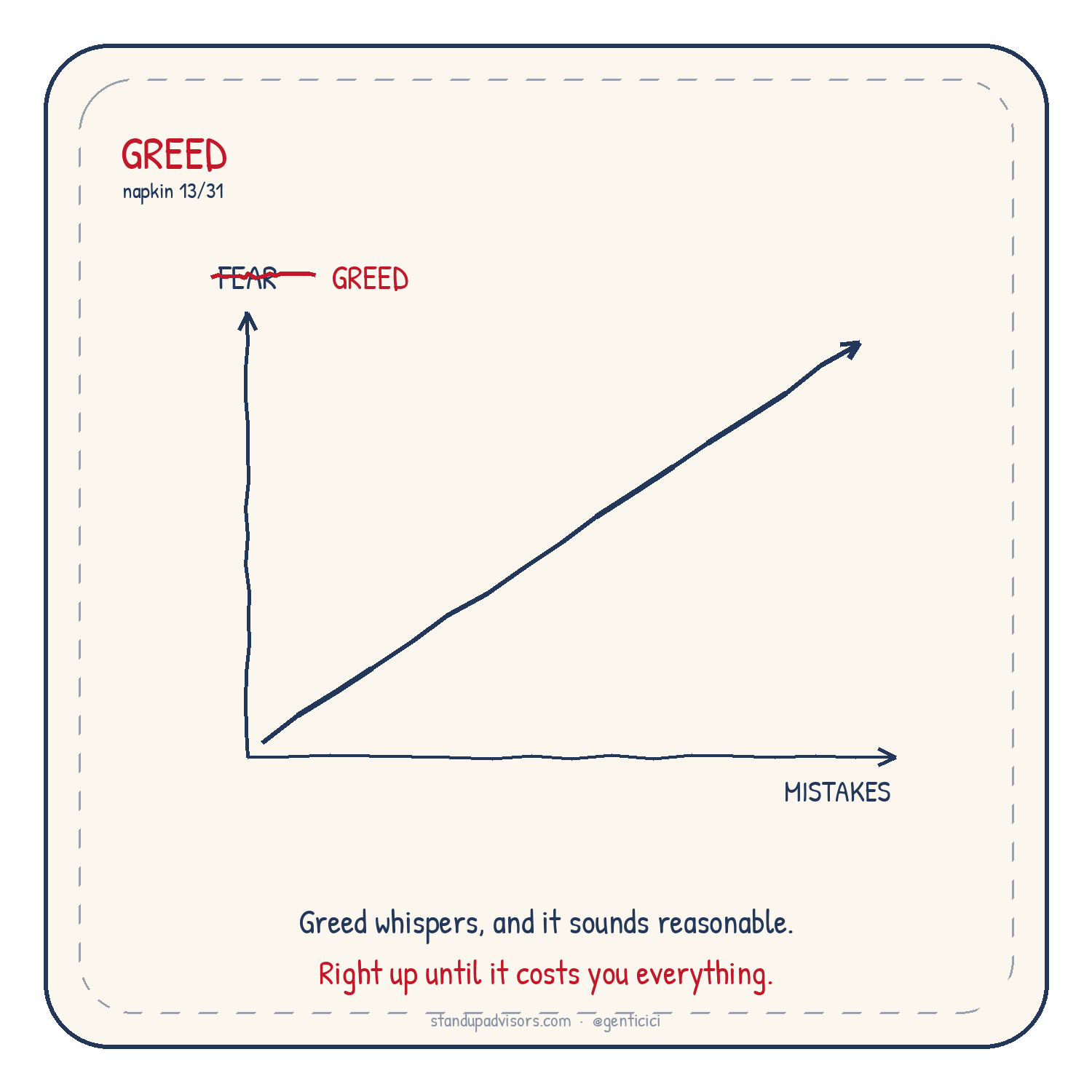
Greed doesn’t announce itself. It whispers, and it always sounds reasonable in the moment.
I have watched option traders chase 300% returns and real estate investors lever up ten to one. Nearly every one of them believed, quietly and sincerely, that this time was different. These were not reckless people. They were smart people, alone in a room, running numbers that felt airtight right up until they weren’t.
Why greed is harder to catch than fear
Fear has a reputation as the great destroyer of portfolios, and it earns it. But fear has one advantage: it feels bad. When you are scared, you know you are scared. You can name it, and once you name it you can slow down.
Greed does not feel like greed. It feels like conviction. It feels like finally seeing the edge everyone else missed. It shows up dressed as research, as a spreadsheet, as a friend’s success story, as a model with every cell filled in.
The math usually works right up until the one input you did not stress-test. A rate moves. A tenant leaves. Volatility spikes for a week. By then the leverage has already done what leverage does: it turns a bad month into a permanent loss.
If a return sounds too good to be true, it is. I have not found an exception in twenty years of looking.
The tell is the size of the bet
Here is what I have noticed about the people who got hurt. The idea was rarely the problem. Plenty of them had a decent idea. The problem was the size. Greed does not usually talk you into a bad investment. It talks you into too much of a reasonable one, with borrowed money, on a timeline that leaves no room to be early.
That is why “boring beats bankrupt” is not a slogan for timid investors. It is a description of who is still in the game ten years later. Boring has one more advantage nobody puts in the pitch: it is still there next year to compound again.
Four questions before the whisper wins
In Who’s Steering? I wrote a system for the moment you feel sure and everyone around you thinks you have lost your mind. It is called The Four Questions, and it works just as well when everyone agrees with you, which is when greed is loudest.
What is the worst realistic case? Not the base case. The bad one.
Can I survive it? Financially, and also without abandoning the rest of the plan.
What is the upside if I am right? In dollars, not in feelings.
Is the asymmetry in my favor? Does the upside clearly outweigh the downside I just admitted I could face?
Four honest yeses and it is a move. One no and it is a hope wearing a spreadsheet. Most of the leveraged bets I have watched fail would not have survived question two.
One question to sit with this week: what is the “sure thing” you almost said yes to, and what stopped you? If nothing did, it is worth asking what would.
As always, if you want to talk any of this through, the door is open. Genti