Financial planning is one of the few things people buy sight unseen. You would not buy a house from a brochure, but people routinely pay thousands for a plan without knowing whether they are getting five useful pages or sixty decorative ones.
So here is one, start to finish. The family is invented. The structure is exactly what a paying client receives.
Meet the Carters, who do not exist
Sam and Riley Carter are in their mid-forties with two kids. Sam runs a consulting business. Riley is a nurse manager. Good income, a house, $260,000 sitting in cash, and no will.
They are fictional. Every number below is an illustration built on assumed returns. It is hypothetical, it is not a client result, and it guarantees nothing. What is real is the engine that produced it and the order of the pages.
Page one: their words, three numbers, three moves
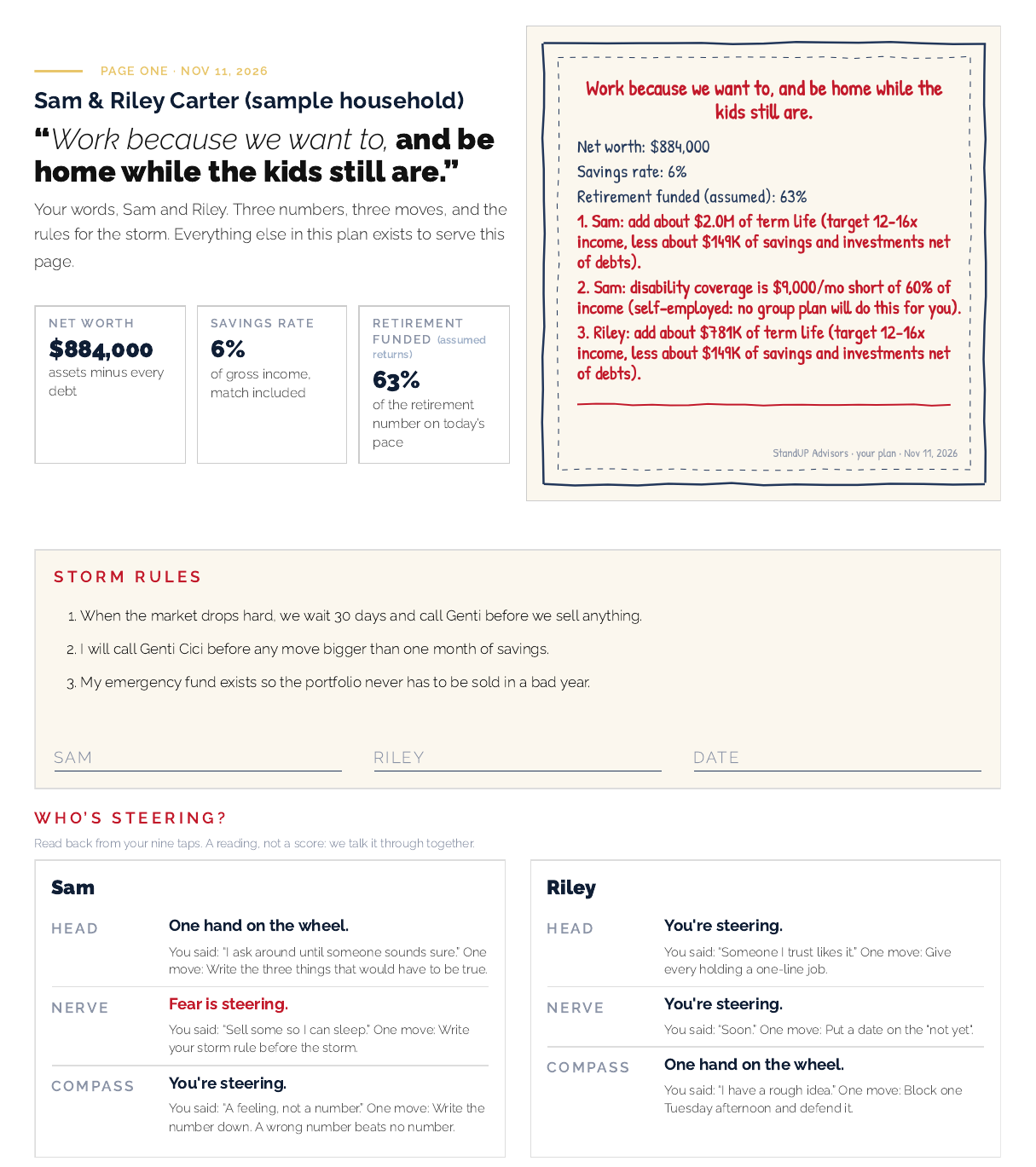
Page one is the only page that has to survive. If the rest of the plan were lost, this one should still tell them what to do.
It opens with their goal in their own words: “Work because we want to, and be home while the kids still are.” Then three numbers: net worth, savings rate, and how funded retirement is. Then three moves, in order.
For the Carters, the first three moves are all insurance. That surprises people. They expected investment advice. But a family that depends on a one-person business, with no disability coverage and thin life insurance, has a hole in the hull. You fix the hull before you adjust the sails.
Storm rules, signed
Under the moves sit three rules for the next crash, with a line for each of them to sign. The first rule is one they wrote themselves: “When the market drops hard, we wait 30 days and call Genti before we sell anything.”
It sounds small. It is the most valuable paragraph in the plan, because the crash is when plans actually die.
Who’s steering
Page one ends with a read-back of nine questions each of them answered separately. Sam’s reads “Fear is steering” on one line, with his own answer quoted underneath. Riley’s does not.
That difference is not a problem. It is the agenda for our first conversation.
Page two: now versus after
This page answers the question people are really asking: is this worth doing?
It shows where the Carters stand today and where the plan takes them if they do the moves. In this illustration, retirement goes from 63% to 132% funded, the simulated odds of the money lasting go from 16% to 81%, and work becomes optional at 61 instead of 64. Idle cash goes from about $205,000 to none, because it finally has a job.
Again: hypothetical, assumed returns, a made-up family. The point is the shape. A plan should be able to show you what it is worth before you act on it.
The rest
Three more pages: six numbers that tell the whole story, where every dollar goes each month, and the full action list, every step with a date and an owner. Nineteen actions for the Carters, nine of them high priority.
Five pages total. Not sixty.
What it costs
A one-time Starter Plan is $1,500, $3,500 or $7,500, depending on how complicated your life is. Half when you sign, half when it is delivered, and we go through it together in a working session.
Whether that is worth it depends on what is at stake. For the Carters, the stakes were a family one accident away from losing its income. Measure the fee against that, not against zero.
One question to sit with this week: if your plan were cut down to a single page, what would be on it?
As always, if you want to talk any of this through, the door is open. Genti