The napkin
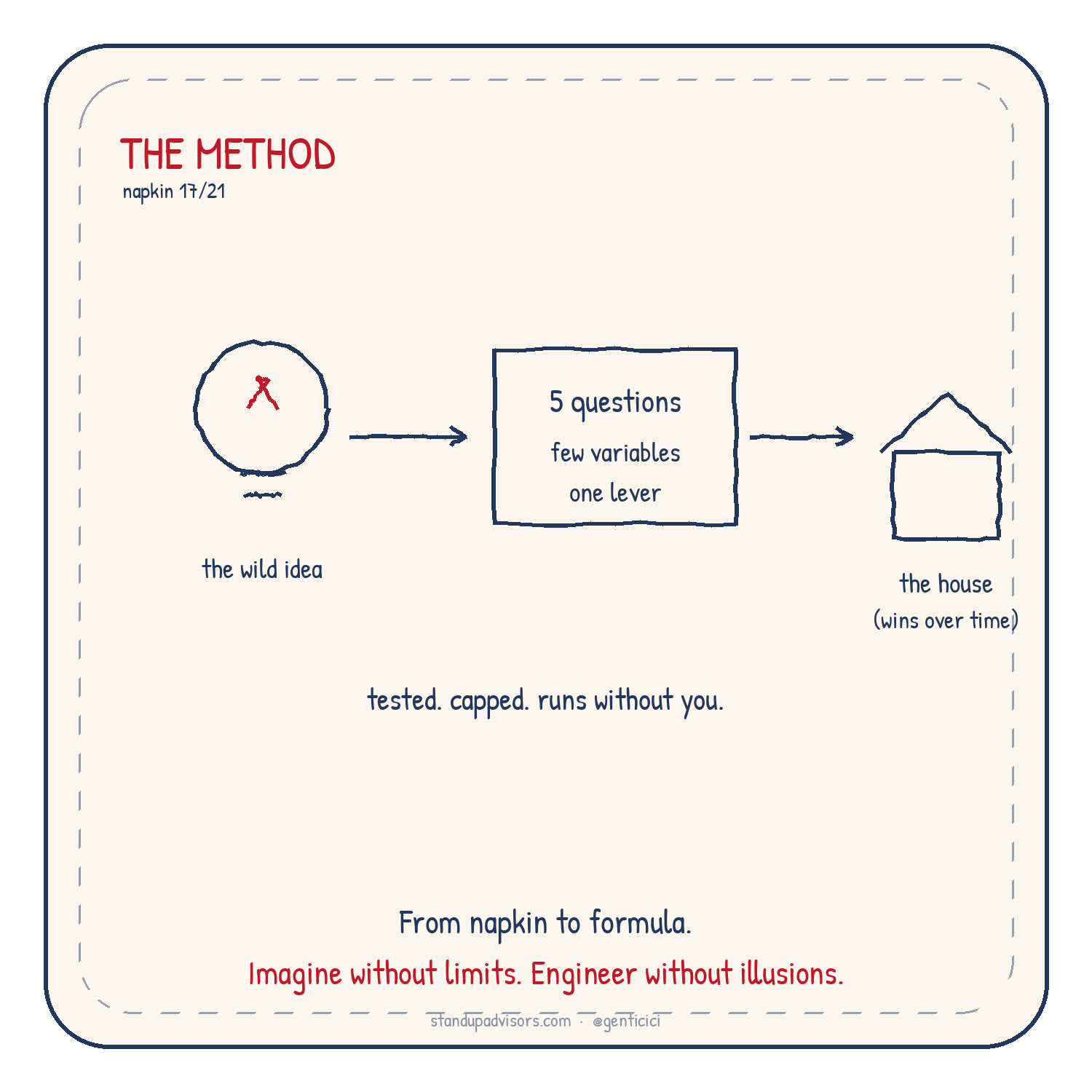
Napkin 17 of 21
The Method: five questions, one lens, pointed at any surface.
If an idea does not fit on a napkin, it is probably not an idea yet. Redraw this one on your own.
You’re afraid your expertise has an expiration date and the next tool will make it worthless.
The advice everyone gives is become an expert in AI. It’s not wrong, but it’s incomplete, because AI is a tool and tools change. Build your identity around mastering each new tool and you’re on a treadmill, always one step behind the machine that’s always one step ahead. The fear of expiring isn’t stupid. Expertise built on a single surface does expire. And generalist can be a flattering word for dabbler, someone who collected surfaces and never went deep enough to matter.
The cost of the treadmill is that you spend the decade chasing tools instead of building the one thing that doesn’t automate: a lens that works across domains. A dabbler collects surfaces. A generalist runs one method across many of them, and the method compounds every time it touches a new field. AI can answer the question. It can’t decide which question to ask, and it can’t start from zero. That nerve, and the judgment to know when to stop, stay yours.
Inputs, constraints, feedback loops, failure modes, the simplest intervention that changes the most. One lens, any domain.
List every field you know at sixty percent or better, and don’t be modest: parenting, woodworking, the sport you played seriously. Pick two. For each, first reimagine it from zero, then run the five questions: inputs, constraints, feedback loops, failure modes, the simplest intervention that changes the most. Watch the same shape appear in both. That shape is your lens. Name it.
The Method: five questions, one lens, pointed at any surface.
If an idea does not fit on a napkin, it is probably not an idea yet. Redraw this one on your own.
The system is free and it works alone. If you want a second set of hands on the wheel, that is what the Purpose Pit Stop is for.