Most Roth conversion math looks at one year. The real money is sitting in a window most retirees never even look through.
Here is the window. The year you stop working, your paycheck disappears. But the IRS has not started forcing withdrawals from your traditional IRA or 401(k) yet. Those Required Minimum Distributions come later, and when they arrive, along with Social Security, they stack on top of each other. In between, there is often a stretch of five to fifteen years where your taxable income drops off a cliff.
The instinct is to enjoy those quiet, low-tax years and leave it at that. The smarter move is usually the opposite.
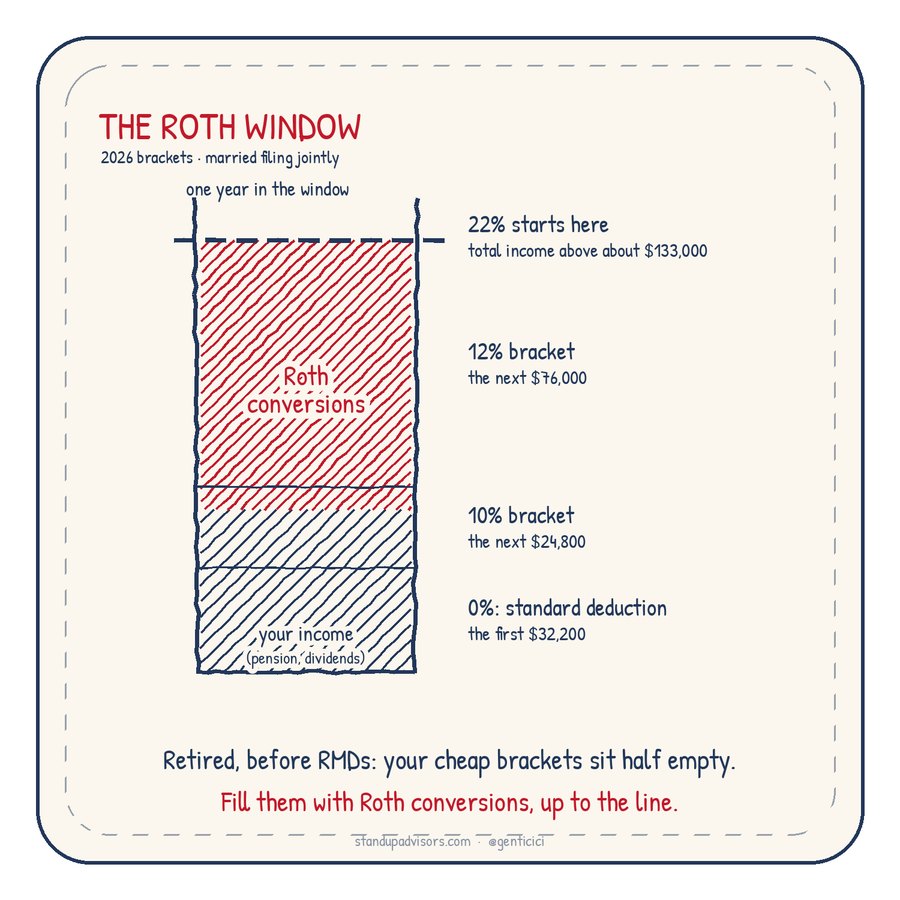
Why the quiet years matter
A Roth conversion moves money from a traditional IRA, where every future withdrawal is taxed, into a Roth IRA, where qualified withdrawals are not. You pay income tax on the amount you convert, in the year you convert it.
So the only real question is when you want to pay that tax, and at what rate. In the window, many retirees sit in the 12% bracket, sometimes lower. Later, once RMDs and Social Security land in the same year, the same dollars can be taxed at 22%, 24%, even 32%. The federal brackets are public. Most people just never line them up against their own timeline.
Pay the tax now at a rate you choose, or pay it later at a rate the government chooses for you.
Converting in the window is choosing the first option on purpose.
Why the window gets sharper, not softer
Two more things make the window worth watching closely.
First, Medicare premiums. Above certain income levels, Medicare charges surcharges, and they are based on your income from two years earlier. A large conversion at 63 can show up as a higher premium at 65. That is not a reason to skip converting. It is a reason to size each year carefully.
Second, health insurance before 65. If you retire early and buy coverage on the marketplace, your subsidy depends on your income. Convert too much in one year and you can lose a subsidy worth more than the tax you were trying to save.
None of this is exotic. It is just arithmetic that nobody does for you, because no form in your mailbox flags it and nobody is paid to point it out.
Seeing it is the hard part
In Who’s Steering? there is a system for exactly this kind of avoided look. It is called The One Look: open the thing you have been avoiding, once, just to see it. No plan required on day one. For most people near retirement, the avoided thing is a simple table: income by year, from now until RMDs begin, with the brackets drawn across it.
Once you see the gap between your income line and the top of a low bracket, the decision mostly makes itself. You fill that gap with conversions, year by year, and stop before the next bracket, the Medicare surcharge or the subsidy edge.
One question to sit with this week: if you are within a few years of retiring, do you know which years will be the cheapest tax years of your life? If not, that is the look worth taking first.
As always, if you want to talk any of this through, the door is open. Genti