The napkin
Napkin 8 of 21
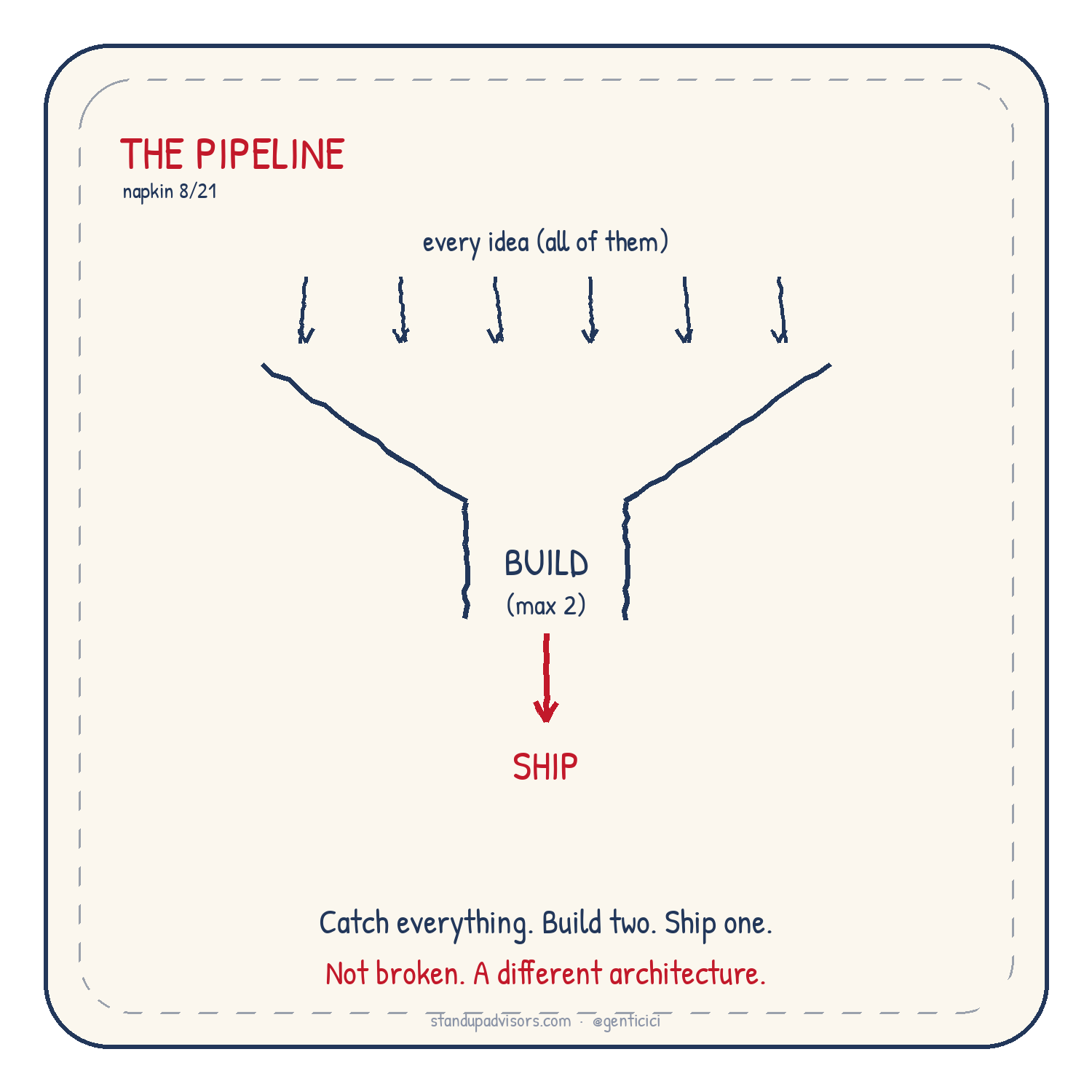
The pipeline: three columns, Capture, Build, Ship, with a hard cap of two in the middle.
If an idea does not fit on a napkin, it is probably not an idea yet. Redraw this one on your own.
You start fast, go wide, and fade before the finish, and you suspect your wiring is the problem.
Thirty-seven tabs open. Two business ideas in a notes app, a half-finished novel, a course abandoned in February, and a partner who asks, lovingly, if you could just pick one thing. The fear isn’t the tabs. It’s the belief that your wiring is defective, that going wide and connecting everything is a bug to be medicated. Losing a job to AI is scary. Being fundamentally broken is devastating. And it isn’t a stupid fear, because an asset with no guardrails really is just chaos with good ideas.
Your brain isn’t broken. It’s a different architecture, and in the AI era it might be the most valuable one there is: AI is devastating at narrow execution and useless at going wide. The cost of believing you’re broken is that you either medicate the orchestra into silence or let it run with no conductor, and either way nothing ships. You don’t need to be fixed. You need the one specific discipline this brain actually needs, and only that one: a cap.
Catch every idea; cap “Build” at two; nothing new starts until something ships. A pipeline for a wide brain.
List everything you’re working on right now in three columns. Capture: every spark, no judgment. Build: what you’re actively making. Ship: the 90-to-100% grind. Now count Build. If more than two things are in it, you’ve found the bottleneck, and it isn’t your brain. Cap Build at two, and let nothing new in until something ships.
The pipeline: three columns, Capture, Build, Ship, with a hard cap of two in the middle.
If an idea does not fit on a napkin, it is probably not an idea yet. Redraw this one on your own.
The system is free and it works alone. If you want a second set of hands on the wheel, that is what the Purpose Pit Stop is for.