“I want to be where the money is.”
I’ve heard some version of that sentence from almost every investor who ended up buying high and selling low. Nobody says it in a panic. They say it calmly, sometimes with a smile, usually right after a friend, a coworker or a feed made money in something they don’t own yet.
It is never framed as chasing. It is framed as opportunity. Someone made money in tech, so that’s where you go, near the top. Then tech cools off and crypto is where the money is, so you rotate there, also near the top. Then it’s whatever comes next, and the pattern repeats. The sentence was never about a strategy. It was about a feeling: the fear of being the only one not in the room.
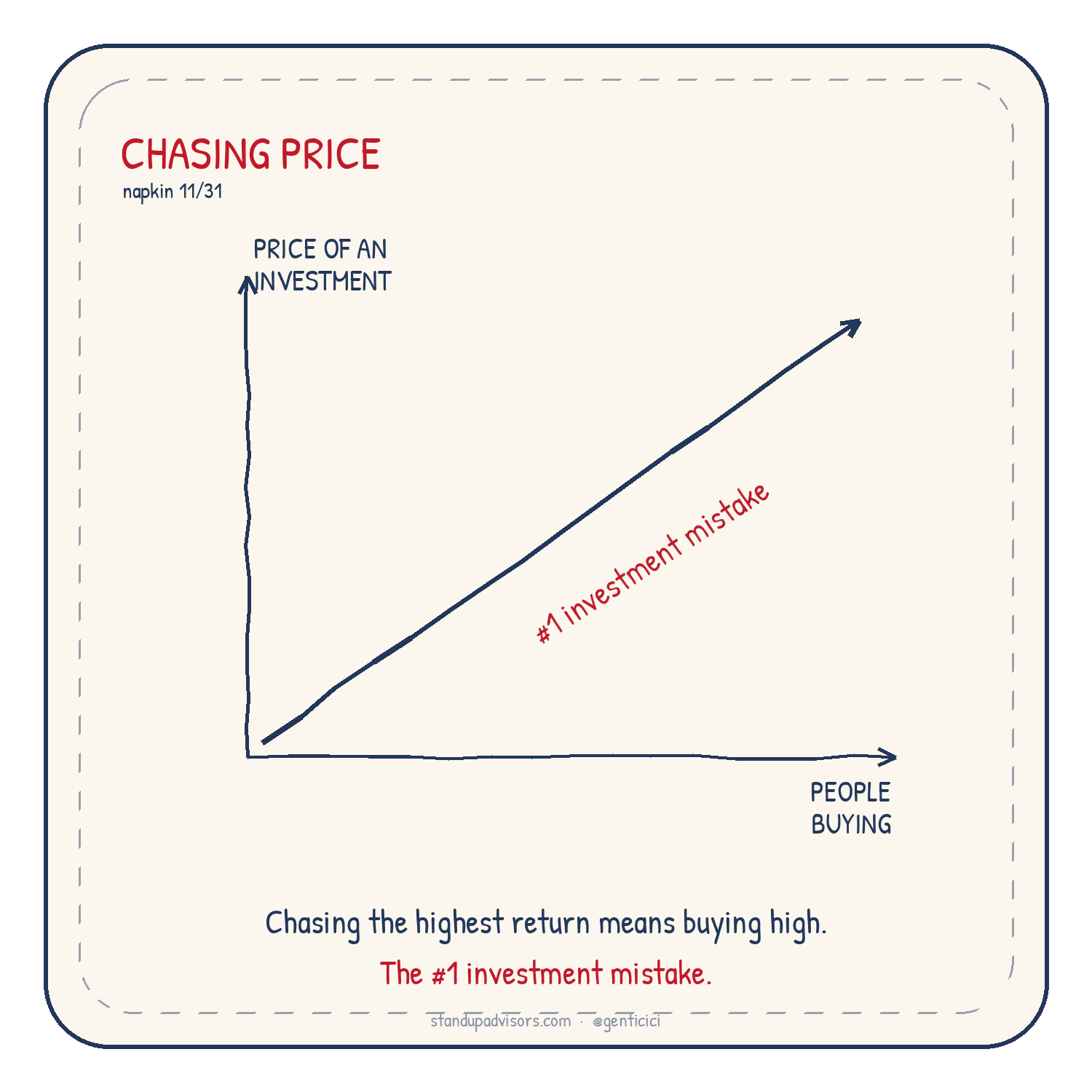
What the feeling costs
Here is the part nobody puts on the brochure. By the time something is obviously “where the money is,” the money has mostly already been made there. The price did its work before you heard about it. What is left for the latecomer is the part of the move that is mostly enthusiasm.
So the chaser buys enthusiasm. And because the same feeling that got them in also gets them out, they tend to sell exhaustion: after the drop, when everyone in the room is quiet again and leaving feels like relief. Follow price instead of a plan for long enough and that becomes the pattern. In late, out late, every time.
Following price instead of a plan means you are perpetually buying enthusiasm and selling exhaustion.
The cost doesn’t show up as one big mistake. It shows up as a slow leak: a little late on the way in, a little late on the way out, repeated for twenty years.
Why smart people do it anyway
This isn’t a knowledge problem. Most people who chase know the rule about buying low. The problem is that the rule is abstract and the feeling is not. Watching other people get richer while you stand still is a specific, physical kind of discomfort, and buying the thing makes it stop for a while.
I wrote a whole chapter about this in Who’s Steering?, because it is one of the oldest fears in money: everyone else is getting rich. The system that answers it is called The Denominator. The short version: the feed shows you everyone who won and almost nobody who lost, so you are comparing yourself to a numerator with the denominator missing.
The boring rule that works
Pick a strategy that fits your actual goals and your actual time horizon. Write down, in calm weather, what you will do when something you don’t own is suddenly everywhere. Then hold the plan regardless of what is hot this quarter.
It won’t feel exciting at dinner parties. It will feel a lot better at year thirty.
One question to sit with this week: what’s the last thing you bought because it felt like everyone else already had? Nothing wrong with the answer. Just notice whether a plan made that decision, or a feeling did.
As always, if you want to talk any of this through, the door is open. Genti