The napkin
Napkin 15 of 21
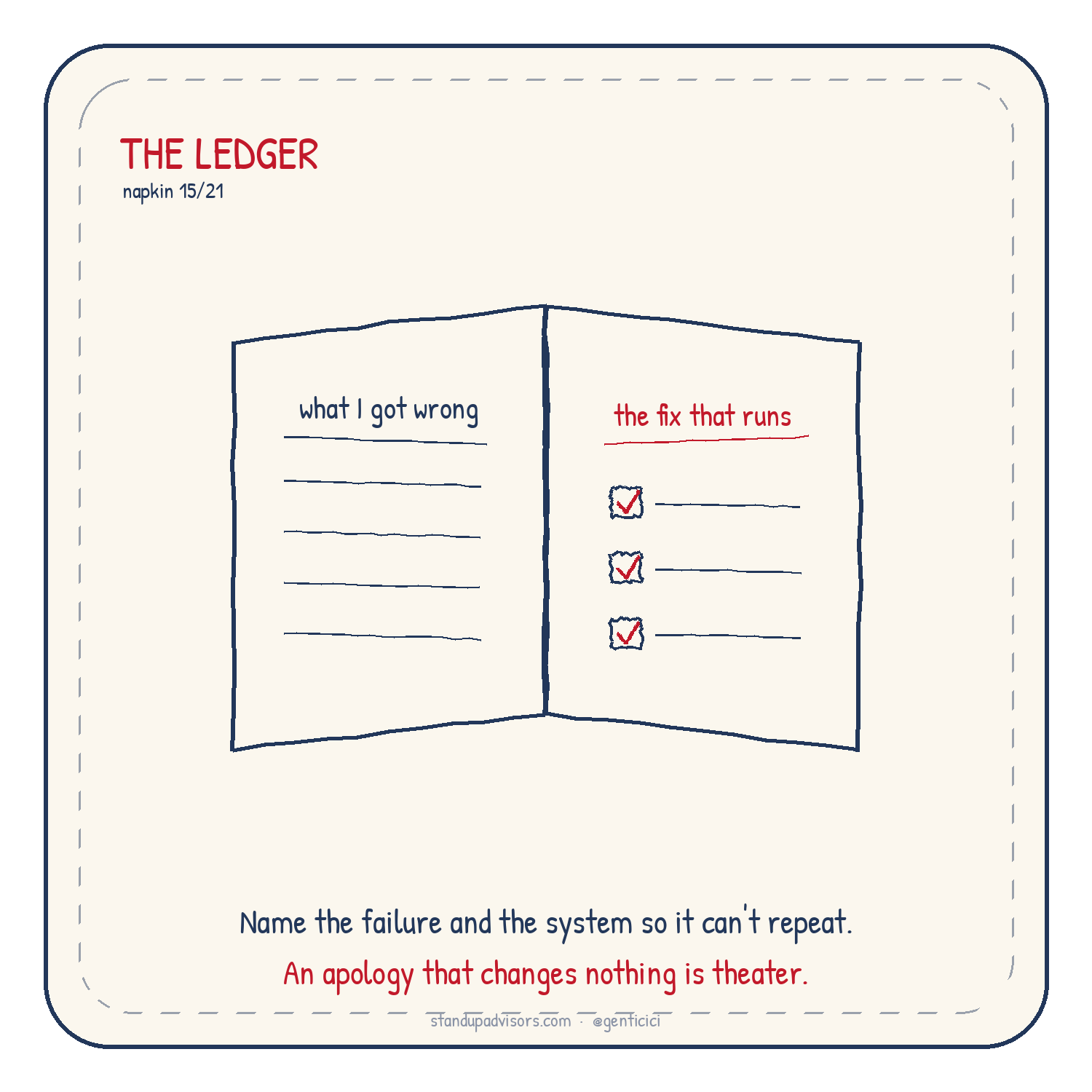
The ledger: what went wrong on one side, and the system built so it can’t repeat on the other.
If an idea does not fit on a napkin, it is probably not an idea yet. Redraw this one on your own.
You’re afraid that the thing you got wrong is who you are, so you never say it out loud.
Every business book is full of winners narrating their wins as if the steps were the reason. Nobody writes the chapter about the marketing that failed, the rule they overrode, the work they were too scared to ship. The fear is that admitting the failure makes it permanent, that the mistake isn’t something you did but something you are. It’s not a stupid fear. Shipping means being judged, and as long as the work sits unshipped it stays in a state of pure potential.
The cost is a performance that never ends. Performing someone who succeeds costs more than being someone who’s honest, and everyone can tell the flawless person is lying anyway. The person who says I was wrong builds more trust in one sentence than the flawless one builds in a decade. But a confession alone is cheap; a list of flaws that changes nothing is a brag that learned to apologize. What counts is naming the failure and the system you built so it can’t quietly repeat.
Name the failure and the system you built so it can’t repeat. An apology that doesn’t change the system is theater.
Name one thing you got wrong, out loud, to someone who matters: the rule you overrode, the stalled project, the season you gave people the tired end of your day. Then name the rule you’ve built so it can’t quietly repeat, something concrete, like nothing new starts until something ships. The confession buys trust. The system is how you earn it back from yourself.
The ledger: what went wrong on one side, and the system built so it can’t repeat on the other.
If an idea does not fit on a napkin, it is probably not an idea yet. Redraw this one on your own.
The system is free and it works alone. If you want a second set of hands on the wheel, that is what the Purpose Pit Stop is for.