The napkin
Napkin 4 of 21
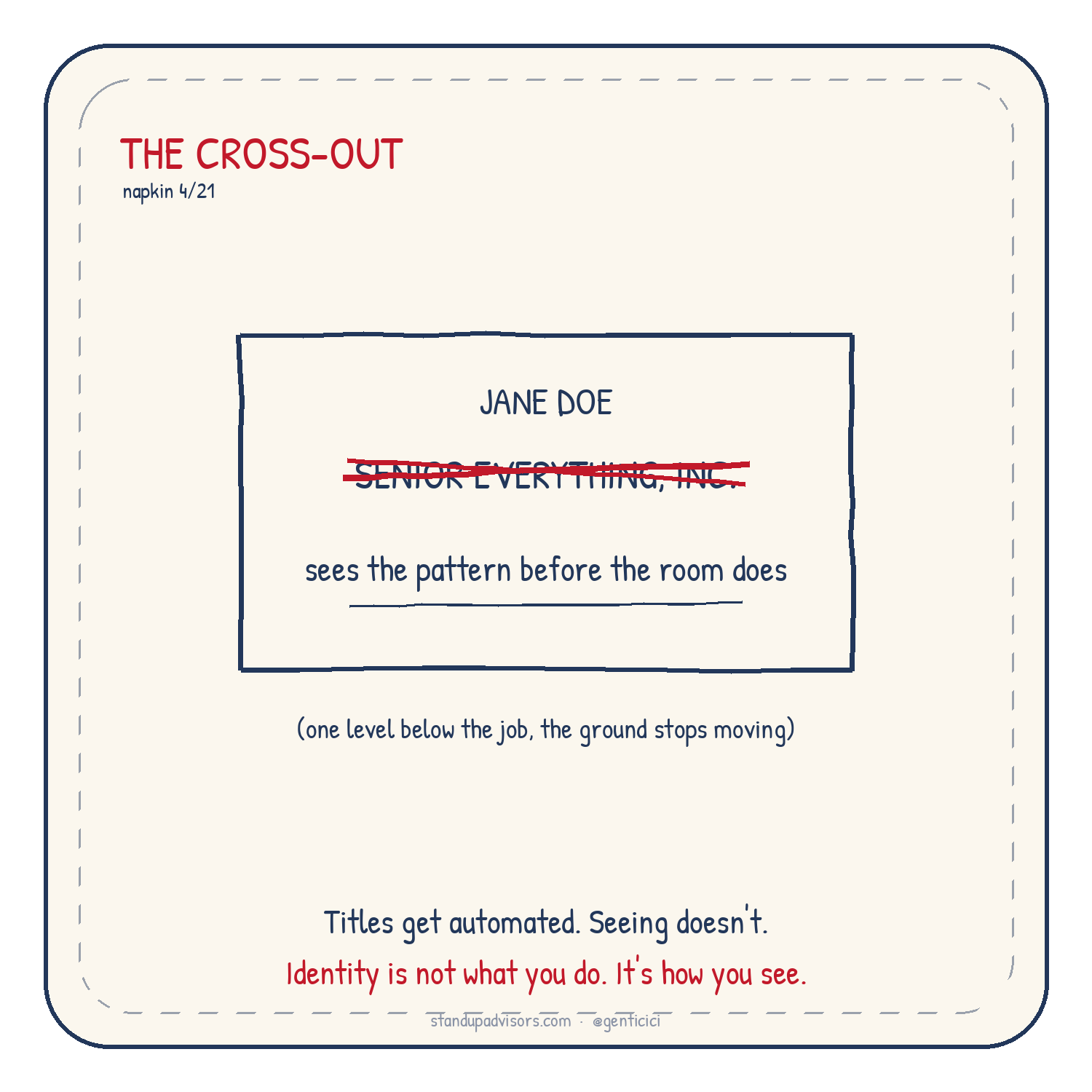
A job title crossed out, with how you see written underneath it.
If an idea does not fit on a napkin, it is probably not an idea yet. Redraw this one on your own.
A machine just did the thing that made you an expert, and you don’t know who you are without it.
You weren’t fired. It’s worse: you’re still there, still respected, and the skill that made you you just got compressed into a prompt. A designer watching fifty layouts appear in ten seconds. An attorney whose junior produces the memo in an hour. This isn’t a hunch. When researchers measured it, exposure to AI rose with education and income. For the first time, automation is climbing the ladder instead of sweeping the floor. The job isn’t gone. The identity is.
The cost of building yourself on the task is that when the task automates, you have nothing left to stand on, and you freeze exactly when you need to move. Here’s the sentence the rest of the book rests on: your identity is not what you do, it’s how you see. Problems don’t get automated. Tools do. Define yourself one level below the job title and you re-attach to a new role faster than the person who only had the task.
Write what you do; cross it out; write how you see. Define yourself one level below the job. (Diagnostic: the Da Vinci Index.)
Write down what you do for a living: the title, the cocktail-party answer. Cross it out. Underneath, write how you think: the problems you’re drawn to, the patterns you catch that others miss, the thread connecting every job you’ve ever had. That second line is your real identity. It doesn’t fit on a business card, which is fine. It doesn’t get automated either.
A job title crossed out, with how you see written underneath it.
If an idea does not fit on a napkin, it is probably not an idea yet. Redraw this one on your own.
Twenty questions that measure how you see rather than what you know: the Cross-Out, done for you.
The system is free and it works alone. If you want a second set of hands on the wheel, that is what the Purpose Pit Stop is for.